

The Rebel Network
The question is no longer whether Artificial Intelligence will change the world. It is who will control it — and whether the small and medium-sized enterprises that create real prosperity will be empowered or erased.
AI is becoming the operating system of the global economy.
Not the chatbot on a phone. Not the image generator that turns a sentence into a spectacle. Not the clever assistant that drafts an email in seconds.
The real transformation is happening beneath the screen.
It is happening in data centres, fibre routes, logistics networks, factories, hospitals, universities, financial institutions, research laboratories, and boardrooms. It is happening wherever data can be turned into prediction, knowledge, automation, and advantage.
And it is raising the most important question of the AI age:
Who will own the intelligence that shapes the future?
Will it belong mainly to a handful of global technology empires with the capital to build the largest clouds, buy the fastest chips, train the biggest models, and set the rules of access?
Or can businesses, communities, institutions, and nations retain meaningful control over the knowledge they create?
For Orient Telecoms, this is not a philosophical exercise. It is the central business challenge of the coming decade.
The company’s answer is not to reject AI, cloud computing, or global technological progress. It is to build another path alongside them: one in which SMEs, SMIs, corporations, universities, financial institutions, technology startups, and public-interest organisations can use powerful AI without automatically surrendering their data, commercial intelligence, and strategic independence.
This is the idea behind The Rebel Network.
Not a rebellion against technology.
A rebellion against dependency.
The battle is not between humans and machines
Every generation has its great technological turning point.
The industrial revolution changed who could make things. Electricity changed where industry could operate. The internet changed how information moved. Mobile technology put the world’s networks into billions of hands.
AI is different because it does not simply move information or automate a single process. It has the potential to influence decisions across nearly every part of the economy: what companies manufacture, how they price, whom they hire, where they invest, which risks they detect, which customers they serve, and which opportunities they see first.
That makes AI an industrial force.
But industrial forces are never neutral. They reward particular forms of ownership, control, infrastructure, and access.
The companies that control advanced models, global cloud platforms, chip supply chains, data-centre capacity, energy contracts, and the networks between them are not merely selling software. They are building the infrastructure through which other organisations will increasingly think, decide, trade, compete, and create.
That infrastructure can create extraordinary value. It can help a manufacturer predict equipment failure before production stops. It can help a university accelerate research. It can help a bank identify fraud more effectively. It can help a logistics provider anticipate disruption before a shipment becomes a crisis.
But it can also create a new dependency.
A business may gain convenience while losing leverage.
It may rent intelligence without ever owning capability. It may place its most valuable information into systems it does not control. It may pay continuously for access while its operating knowledge—the patterns inside its customer relationships, supply chains, pricing decisions, technical processes, and internal documents—becomes increasingly exposed to external platforms.
That is the strategic tension many business leaders are beginning to recognise.
As Palantir chief executive Alex Karp has argued, enterprises are becoming more alert to the risk of paying for AI consumption while allowing the proprietary “alpha” in their data—the hard-won advantage that makes their business distinct—to be captured, diluted, or made useful elsewhere. The point is not that every external AI provider is acting improperly. The point is more fundamental: when an enterprise does not control its data environment, compute strategy, and AI architecture, it may not control its future advantage either.
That is why the AI debate is no longer only about models.
It is about sovereignty.
The people who build the real economy cannot be left behind
The global economy is often described through the lens of its largest corporations.
The biggest valuations. The most powerful platforms. The most celebrated founders. The companies large enough to move markets with a single earnings call.
But the real economy lives closer to the ground.
It lives in the manufacturer turning materials into essential products. The engineering firm solving difficult local problems. The logistics operator keeping goods moving. The clinic serving families. The financial institution supporting entrepreneurs. The university training the next generation. The research team pursuing breakthroughs. The family-owned exporter building a reputation over decades.
These organisations are not peripheral to prosperity. They are its foundation.
SMEs and SMIs create employment. They build skills. They sustain communities. They keep money circulating through local economies. They turn ideas into products, services, and livelihoods.
Yet they face the hardest version of the AI challenge.
A global technology company can hire thousands of engineers, purchase vast computing capacity, absorb failed experiments, and negotiate infrastructure contracts at an almost unimaginable scale. A smaller enterprise cannot.
The owner of a growing manufacturer is already managing production, quality, suppliers, finance, customers, staff, and cash flow. The founder of a technology startup is racing to find product-market fit before the runway runs out. A university must protect research integrity and sensitive data. A financial institution must balance innovation with security, compliance, and trust.
None of them has unlimited time.
And time may be the scarcest resource of all.
This is why the story of AI cannot become a story in which the few become more powerful simply because they were already powerful.
A future where smaller businesses can only rent intelligence from larger platforms may be efficient in the short term. But it risks becoming fragile in the long term. It concentrates value, weakens local agency, and turns independent businesses into customers of systems whose rules they did not help shape.
Orient Telecoms believes there is another possibility.
A business may be small.
It does not have to be alone.
The idea: a republic of independent enterprises
For generations raised on stories of distant galaxies, this tension is familiar.
There is always an empire. Vast. Efficient. Technologically superior. Confident that scale itself is proof of destiny.
And there is always a rebellion.
Not because the rebels believe the odds are equal. They are not.
Not because they can outspend the empire. They cannot.
They resist because surrender is not a strategy.
They resist because a future controlled entirely from one centre is not a future worth accepting. They resist because different worlds, communities, and people must retain the ability to make choices for themselves.
Orient Telecoms is building its own version of that idea for the AI economy.
It calls this vision the Republic of Collective Rebel Alliances: a federation of businesses and institutions that remain independently owned, locally rooted, and commercially distinct, while gaining stronger access to secure connectivity, private compute, enterprise AI, and collective capacity.
This is not a claim that a network of SMEs can suddenly equal the scale of the world’s largest cloud providers.
They cannot.
Nor should they try to imitate them.
The purpose is different.
The purpose is to ensure that businesses have a choice: to keep sensitive data closer to home, to build their own AI capability, to participate in shared infrastructure on their own terms, and to access greater collective capacity without becoming permanently dependent on a single external power.
The collective does not erase independence.
It protects it.
From connectivity provider to infrastructure of independence
Orient Telecoms has spent years building the foundations required for this moment.
Founded in 2016 as a UK company, Orient has developed managed telecommunications capabilities while expanding its regional operating presence across Southeast Asia, including licensing arrangements in Malaysia and Thailand, a strategic base in Kuala Lumpur, and managed network delivery across the region.
Its portfolio includes Metro Ethernet leased lines, Dedicated Internet Access, IP transit, cross-border connectivity, International Private Leased Circuits, SD-WAN, and high-capacity backbone services.
That heritage matters.
The AI age will not be won by a model alone.
AI needs networks that can move data reliably and securely. It needs low latency. It needs protected environments. It needs compute. It needs the ability to connect branches, factories, offices, campuses, clouds, and countries without turning every customer into a telecommunications or cybersecurity specialist.
Orient’s transformation brings together three capabilities that are too often treated separately.
Three capabilities, one architecture
The nervous system — moving information where it is needed, reliably and securely.
The intelligence layer — turning information into useful insight and action.
The engine — making demanding workloads possible. The purpose is not merely faster technology. It is greater control.
WarpCore: the nerve system of the alliance
Every alliance needs trusted routes.
In the digital economy, those routes are fibre, Ethernet, internet gateways, private circuits, and managed networks. Without them, a business is not an integrated organisation. It is a collection of disconnected sites, isolated data, fragmented applications, and delayed decisions.
Orient’s Network Connectivity & Internet Services are being expanded through the WarpCore Network concept: a carrier-class optical Metro Ethernet environment designed to support scalable enterprise connectivity, from hundreds of megabits per second to multi-gigabit and higher-capacity requirements.
For a serious business, connectivity is no longer an overhead line item.
It is strategic infrastructure.
It is how a manufacturer connects sites and systems. How a financial institution protects the movement of information. How a university links researchers and data environments. How an MNC coordinates operations across markets. How a startup reaches customers at speed.
Alongside it, Orient is developing the Orient Hyperlane Mesh, or OHM, as a managed SD-WAN approach intended to connect distributed sites, systems, and teams through a more unified architecture.
The point is simple: enterprises should be able to focus on what they build, serve, discover, finance, repair, design, and deliver.
They should not need to build a private telecommunications department simply to join the AI economy.
TransWarp: security is not an add-on
In the old technology world, security was often treated as a final checkpoint.
Build the system. Connect the users. Launch the service. Add protection afterward.
That approach is no longer enough.
In the AI era, data is not merely a record of what a company has done. It is the map of what the company knows.
It contains customer relationships. Supplier terms. Financial records. Research. Intellectual property. Clinical information. Legal files. Production processes. Commercial judgement accumulated over years of difficult work.
The intelligence derived from that data may become more valuable than the data itself.
That is why Orient’s TransWarp Secure Network is positioned as a protected delivery environment for approved organisations with heightened security needs. Its framework includes measures such as traffic scrubbing, DDoS mitigation, deep packet inspection, continuous monitoring, and managed security controls.
For privacy-conscious and regulated organisations, security cannot be an optional feature.
It must be part of the architecture.
The question is no longer simply, “Can AI help us?”
The harder question is, “Can it help us without exposing what makes us valuable?”
BORG Cube: bringing compute closer to the enterprise
The boldest part of Orient’s vision begins with a straightforward proposition.
If a business wants meaningful control over its AI future, it needs meaningful control over some of the compute that powers it.
That does not mean every business must build a data centre. It does not mean every organisation must hire a large machine-learning team or manage racks of specialised hardware.
It means an enterprise should have an alternative to permanent dependence.
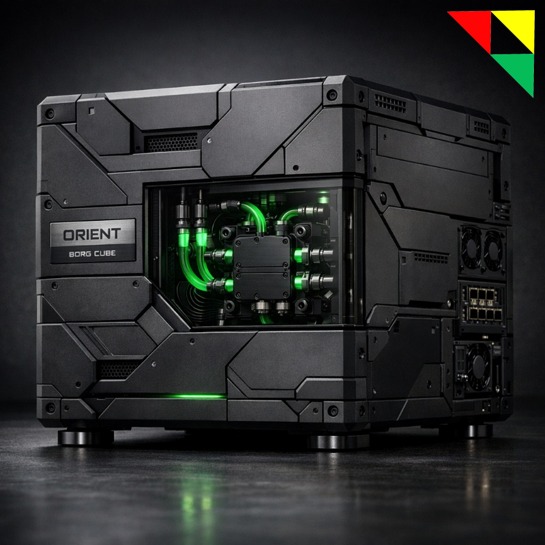
The Orient BORG Cube—positioned as a Bare-metal On-premise RDMA-connected GPUs Cube—is intended to provide an enterprise-controlled AI supercomputing environment for organisations that require stronger data privacy, private compute resources, and greater information sovereignty.
The idea is powerful because it shifts the location of capability.
Instead of assuming that all intelligence must live in a distant hyperscale cloud, an enterprise can keep sensitive workloads, internal knowledge systems, models, and data closer to its own environment.
This is not isolation.
It is choice.
A company may use private compute for confidential work, while accessing external or collective capacity for workloads that require scale. It may decide which information remains within its own controlled environment and which tasks can safely operate beyond it.
That is a more balanced relationship with the cloud.
Not anti-cloud.
Not anti-progress.
Pro-choice. Pro-control. Pro-enterprise.
ABS: AI that works where work actually happens
Powerful hardware is meaningless if it does not help people make better decisions.
That is the role envisioned for Orient ABS, or AI Business Solution: an enterprise AI workspace designed to bring private compute, secure connectivity, and usable business tools into one environment.
The future of enterprise AI will not be a single public chat window.
It will live inside workflows.
A procurement team may use it to identify supplier risk. A logistics operator may use it to interrogate routes, delays, and demand patterns. A manufacturer may search maintenance records and production data. A legal team may analyse internal contracts inside a controlled environment. A university may help researchers navigate complex bodies of approved knowledge. A financial institution may support internal analysis while maintaining appropriate controls.
The goal is not to replace human judgement.
It is to give human judgement more leverage.
To reduce repetitive searching. To make knowledge easier to find. To remove friction. To give skilled people more time for relationships, creativity, decision-making, care, and work that genuinely requires a human being.
Tachyon Cloud and ExaHive: the strength of the many
A single enterprise-controlled compute environment can be valuable.
But the deeper potential begins when independent nodes can connect—securely, selectively, and under clear commercial and technical rules—to form a larger resource.
This is the vision behind Orient Tachyon Cloud and Orient ExaHive.
Tachyon Cloud is conceived as an AI-focused RDMA network cloud connecting multiple Quantum SlipStream nodes and BORG Cube deployments. ExaHive is Orient’s proposed grid-supercomputing model: a collective fabric of connected enterprise compute resources.
The concept is not that every organisation must share its data.
It should not.
The concept is that independent organisations can retain their own identity, priority, and control, while accessing wider capacity when they need it—subject to defined security, technical, and commercial governance.
This is federation.
One business may not own all the compute it needs for every future workload. But it can host what is essential, protect what is sensitive, and draw on additional collective resources for temporary, advanced, or large-scale projects.
Each node remains independent.
Each node can add resilience.
Each node can strengthen the larger network.
This is the idea Orient is planting: that collective capability can give independent enterprises a fighting chance in an age of concentrated technological power.
BEAST: building bridges across borders
The AI economy will not stop at national borders.
Supply chains cross continents. Research crosses time zones. Trade moves through ports, factories, financial centres, and digital platforms. The commercial future of Southeast Asia is inseparable from South Asia, Europe, the Middle East, Australia, and the wider world.
Orient’s planned BEAST submarine cable initiative—British East-India & Asia Submarine Transmission Cable System—is intended to support this long-term vision through routes connecting strategic locations across the United Kingdom, Europe, Oman, India, Malaysia, Thailand, Singapore, Indonesia, and Australia, with further expansion envisioned over time.
Submarine cable infrastructure is not built overnight. It requires planning, partnerships, financing, engineering, regulatory work, and discipline over many years.
That is precisely why it matters.
The future will belong not only to those who build impressive AI models, but to those who build resilient pathways for data, enterprise collaboration, and distributed intelligence to move safely across the world.
A better AI economy is still possible
The choice ahead is not between embracing AI and rejecting it.
That is too simple.
The real choice is between different models of ownership.
One future is easy to imagine. A small number of platforms become the default environment for business intelligence. Their clouds become unavoidable. Their models become essential. Their commercial terms become the practical terms of participation.
Another future is possible.
In that future, global platforms remain important. They continue to innovate. They continue to provide valuable services.
But they are not the only source of intelligence.
Businesses can retain more control over their sensitive data. They can deploy private AI environments. They can build enterprise capability rather than merely consume it. They can join collective infrastructure without becoming subordinate to it.
And they can do this while remaining connected to the global economy.
That is the future Orient Telecoms wants to help build.
Not a fantasy of easy victory.
Not a promise that smaller businesses can defeat every global empire at its own game.
But a more realistic and more important ambition: ensuring that the organisations which employ people, build communities, conduct research, move goods, create products, and sustain everyday life are not reduced to spectators in the AI age.
The difficult journey is ahead.
The technology will evolve. The competition will intensify. The powerful will become more powerful if nothing changes. The pressure on energy, infrastructure, resources, and the natural world will demand more thoughtful choices, not fewer.
But history has repeatedly shown that the future is not shaped only by those with the largest machines.
It is shaped by those with the strongest ideas.
Orient Telecoms is planting one now.
That AI should expand human agency—not quietly take it away.
That businesses should have the tools to compete without surrendering their independence.
That the many, connected with purpose, can become stronger than the few expect.
The invitation
For SMEs, SMIs, corporations, MNCs, technology startups, universities, financial institutions, and organisations determined to remain masters of their own future, the invitation is clear:
- Connect through the WarpCore Network.
- Protect critical information through TransWarp.
- Build private capability with the BORG Cube.
- Transform workflows through Orient ABS.
- Access collective scale through Tachyon Cloud.
- Strengthen the wider network through ExaHive.
- Reach across borders through BEAST.
Do it for your business.
Do it for the knowledge your people have built.
Do it for your customers, employees, communities, and the generations that will inherit the world this technology helps create.
The question is not whether resistance to the global tech-empire is futile. The age of AI will be defined by infrastructure. The real question is whether that infrastructure will serve only the few—or strengthen the many.
Orient Telecoms is building the Rebel Network because the answer is still ours to decide.